2012/03/11

Breizh Cafe Creperie - Shinjuku Stn, Tokyo


It's not uncommon to smell the sweet, fresh-made scent of crepes wafting in the breeze as you walk around Tokyo. There are many tiny stalls dotted around the city that will make crepes with fresh fruit or jam, cream or custard, ice cream or cheese cake.  Some are good, some are not; but for an authentic French crepe, one must either fly to gay Paris or simply visit your local Breizh Cafe.  Brieizh offers not only desert crepes, but also savoury buckwheat galettes (non-sweet pancakes) filled with cheese, egg, assorted vegetables and meat.  The desert menu has light sweet crepes topped with fruit, jam, sauces and ice cream.  In particular,
Dame Blanche
the chocolate sauce is rich and mellow; it obviously hasn't come from a bottle labelled Hershey's.  Breizh prides itself on the quality of its ingredients and this is what makes the crispy galettes and soft crepes so amazingly delicious.  It's hard to recommend just one galette, most are great and the same goes for the crepes.


Complete Tomate Champignon
 It's more worthwhile to go to Breizh for lunch during the weekdays as they have a special lunch course that is much cheaper than dinner.  At Shinjuku Takashimaya, the weekday lunch course is offered from 11am to 3pm.  There is a different menu for dinner, weekends and holidays.  For the weekday galette lunch course, you can get a classic galette of your choice, salad and drink for ¥1480.  With one of: soup/dessert crepe/ bowl of ice cream, it becomes ¥1680.  The last course choice is a Caesar Salad galette with a drink and soup for ¥1680.  The lunch galettes offered are the
Complete Artichaut
simple "complete" ones.  For example, the "complete tomate" has egg, shoulder ham, Swiss gruyere and tomato.  (On the dinner menu, this galette alone is ¥1280.)  The desert crepe lunch menu comes directly from the dinner menu but is more limited.  For the drink choice, there is a wide variety of coffees and teas but they also offer 3 types of alcoholic cider: dry, sweet or organic.

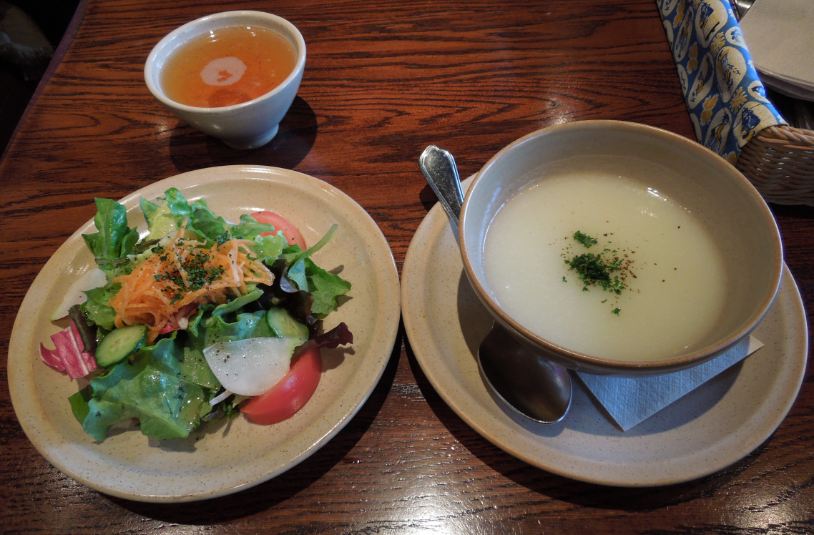
Soup, salad and a cup of cider
If you choose the soup course, be careful to inquire as to the soup of the day.  The pumpkin soup is fantastic, but not all are. I recently had a soup at Breizh where the consistency reminded me of potatoes and there seemed to be a hint of onion, but it was so bland that I could not tell what it was.  All in all, not one I would choose again.


Briezh also offers seasonal galettes and crepes.  The seasonal crepes usually feature fresh fruit but I've recently had several where the fruit had been preserved.  There are several branches of Breizh Cafe such as Le Bretagne in Omotesando Station - Yokohama station, Tokyo station, Akasaka station, etc.  The Breizh Cafe on the 13th floor of the Shinjuku Takshimaya building is smoke-free.


For a general map of my restaurants, visit :  My map

2012/02/27

Kua 'Aina Burger Restaurant - Shibuya Stn, Tokyo


 There's nothing sadder than watching tourists queuing at a McDonalds or Burger King.  I feel like saying "Stop! Stop! There is another choice!"  It's not that I don't understand their yearning for something familiar amidst the exotic and strange.  I've known perfectly sane Japanese people who bring Japanese rice with them when they go overseas.  But honestly, if you've paid several hundred dollars to fly to Tokyo and probably an equally large amount for your hotel, why not spend a few extra bucks for a really good hamburger at Kua Aina.  And since Kua Aina is originally from Hawaii, it's should be just as comforting as the other American fast food chains.  Ordering at Kua Aina in Tokyo is even easier than Mickey D's because most branches have a huge English menu written on a chalk board attached to the wall by the cash registers and the usual picture menus at the cash registers written in English and Japanese.

 Kua Aina's signature burger is the avocado 1/3-lb burger which is topped with lettuce, tomato, a slice of grilled onion, mayonnaise and of course, avocado.  Each table has ketchup and mustard squeeze bottles, but the burger doesn't really need either.  The avocado burger set comes with fries and a drink but the price varies a little for lunch or dinner.  Lunch is generally ¥1280, with dinner being ¥1380 but having an few extra onion rings tossed in.  Sets can also be had for the regular hamburger, bacon burger, cheese burger, and pineapple burger.  The meat patty can be upgraded to 1/2-lb for an extra ¥200 and extra toppings can be added at a cost:  cheese (¥120), pineapple (¥100), pickles (¥120), bacon (¥230), and avocado (¥230).  Along with the usual array of drinks, Kua Aina offers guava and momi tea.  The momi tea comes with tapioca balls but since it only comes in a large size, you'll have to pay the difference to upgrade if you order this with the set (¥120).  The guava is a bit of
Dinner menu
a novelty - it isn't offered it at many restaurants, but the Ceres brand of fruit juice has a guava juice that tastes much better.  Under the alcohol section of the menu is a beer set, that has not been translated into English.  If you order this set, you get draft beer, french fries and onion rings: small (¥680), medium (¥830) and large (¥980).  The sizes probably refer to the cup sizes for the beer.

  For those who prefer something lighter than 150g of beef, there's also the usual cold lunchmeat sandwiches: turkey, roast beef, pastrami, etc.  Kua Aina also offers a Mahi Mahi fish sandwich.  The mahimahi fish is also known as dolphinfish but is not related to actual dolphins.  Like the burgers, the Mahi Mahi sandwich comes with lettuce, tomato, onion and tartar sauce instead of mayonnaise.  There are multiple choices for bread: white, hearth rye, multi-grain bread slices or a kaiser roll.  If you get the Mahi Mahi when it's just off the grill, it can be quite good; however, it sometimes comes out cold, the edges completely burned, or worse of all, dry.

 Though the menu offers a lot of side dishes, most are not worth trying: the soups are terrible, the salads are ok, the chicken fingers dry.  The only good side dishes are the onion rings and the french fries, which are part of the dinner set already.   The onion rings are great but very oily, so the small portion that comes with the dinner set is a reasonable daily amount to ingest.

 There are multiple Kua Aina locations throughout the Kanto area: Shibuya station, Tokyo station, Ometsando station, Kamakura station, Sakuragicho/Yokohama station, Odaiba station, etc.  In general, Shibuya, Tokyo and Kamakura tend to be very good. I haven't been to the other ones enough times to judge but they all seemed decent except the one by Omotesando station which I have been to many times and been often disappointed.  It is unreliable - with the burger over-cooked and dry and the fries soggy and limp (every other branch manages to make them crispy and delicious - why not this one?).  If you're willing to walk an extra 10 mins, you can get to the Shibuya branch which have wonderful burgers - slightly pink in the centre, but not bloody.  If you don't like yours this way, you can ask the staff to make it a bit more well done when you order. All locations seem to be smoke-free or, if they have the space, to allow smoking on a separate floor or an outdoor area.  This is a bit annoying in the spring, when it's nice to have a meal in the sunshine and fresh air -unfortunately, the air is usually tainted by cigarette smoke.  But at least all Kua Aina's have a proper non-smoking room, which is better than most places in Japan.

 Each branch has a few differences.  For example, the lunch menu usually runs until 5pm and then it's switched for the dinner menu.  Some branches seem to run the hours differently and the Shibuya branch is one of them.  The last time I went there was at 4pm.  It was not the typical lunch menu that I had seen at other branches where there are a limited number of lunch sets for slightly cheaper than the dinner sets. At the Shibuya location, each sandwich/burger could be made into a set by adding ¥300.  The Mahi Mahi sandwich is not usually offered as a set at other branches, so this is a far better deal at Shibuya.  However, the avocado burger set comes out to be about the same price as the dinner set but you don't get the onion rings.  If you really want a burger in the late afternoon, you're far better off paying the extra ¥100 to get a perfectly cooked burger at the Shibuya branch.


For a general map of my restaurants, visit :  My map

2012/02/26

Tatsunoya Ramen Restaurant - Shinjuku Stn, Tokyo

 One of my favourite restaurants in Shinjuku is Tatsunoya, a ramen restaurant that serves tonkotsu (pork-bone broth) ramen and tsukemen.  The piping-hot tonkotsu ramen is great for wintertime but not during the humid Tokyo summer when just walking down the street causes sweat to pour down your neck.  So when you crave noodles in summer, luke-warm tsukemen is a more practical solution.  Tsukemen consists of cold noodles and accompaniments that are dipped into a warm broth.  Both are tasty:  the tonkotsu being a bit saltier of the two but having soft pieces of cha shu (bbq pork); the tsukemen more filling since it comes with a porridge as well as noodles but the pork pieces are tougher.  Whenever I visit Tatsunoya, I generally alternate between the tsukemen and the tonkatsu with a hard-boiled egg (which always has a perfect, slightly-runny yolk) and finish with the torokeru purin, which translates directly into 'melts in your mouth pudding'.   It's made from yellow bean and is utterly amazing.

  When you enter the shop, simply place your money in the vending machine on the right and choose from the picture menu.  Each bowl of ramen comes with 2 pieces of cha shu, green onion, fungus and a serving of thin, straight noodles. The shop offers tonkotsu in 2 ways: regular and strong-flavour (with added miso paste).   The top row of the vending machine, from right to left is:  an extra serving of noodles (¥100), regular tonkotsu (¥700), strong-flavour (¥750), regular with a hard-boiled egg (¥800), strong flavour with a hard-boiled egg (¥850).   Tsukemen is on the 2nd row from right to left: small (¥750), medium (¥750 - yes, you've read it right, the same price as the small), and large(¥850); followed by extra vegetables (¥100) and an extra egg (¥100).

Torokeru purin


 The third row are side dishes: a small bowl of rice with mentaiko (pollock roe - ¥250), rice with tororo (grated Japanese yam - ¥250) and rice (¥150).  The fourth row is: extra green onion (¥100), 3 extra slices of cha shu (¥250), and the last in this row is torokeru purin (¥300).  The last row is a bottle of beer (¥400).


Once you have received your pink tickets and got your change back from the machine, the waitress hovering nearby will show you to your seat.  Glasses of water will be placed in front of you and the waitress will take your tickets.  This shop offers to prepare noodles to differing consistencies: harigane (extremely hard), barikatai (kind of hard), katai (hard), futsuu (normal), yawarakai (soft), bariyawarakai (very soft).  Each seat usually has a card on it, with these options on the bottom right.  If you have ordered ramen, this is the first thing that she will ask you.  If you order beer, she will ask you how many glasses and you can simply count with your fingers.  If you order pudding, she will ask before or after, so simply say 'ato' (after).

 After stating your preferences to the waitress, you'll notice 3 jars in front of you.  These are the appetizers and are meant to occupy you until your order arrives.  Simply use the chopsticks to scoop some into the small white dishes.  Do not use these chopsticks to eat with.  The disposable chopsticks are in the rectangular box under the white dishes.

Tonkotsu ramen
 Then the ramen arrives, which most people seem to inhale.  If you have broth left after eating all the noodles and are still feeling peckish, simply order another serving of noodles by flagging down a waitress, pointing to your bowl or saying 'kaedama' and giving her ¥100 - this is possible for both ramen and tsukemen.  If you order another serving of ramen, you'll have to choose the hardness again.  Note that this is for noodles only, no extra broth will be forthcoming.

Tsukemen comes with green onion, bamboo shoots, seaweed and pork.
 When you have completely finished your tsukemen noodles, you'll probably still have quite a bit of broth left.  Flag down the waitress, point to your empty noodle plate and nod to her question.  She'll bring you a bowl of warigae, rice porridge, which you're supposed to dump into the broth to dilute it.  It's still remains flavourful and this allows you to spoon up all the bits of meat on the bottom along with all the broth.

 The restaurant itself is a bit cramped, with only 2 tables at the back.  The majority of the seats are stools at the counter which runs most of the length of the restaurant.  However, the counter seats allow you to see directly into the kitchen where the staff can be seen flinging ramen noodles into the air.  It's also comforting to see the cooks place the already clean bowls into boiling hot water right before they fill it with noodles and broth.  Hygiene is sometimes a bit questionable at ramen shops- I've come across places where I've wondered if the bowls are only cleaned once a day and even then it's probably only done by the cockroaches during the night.  In a typical ramen shop kitchen,  the water from the noodles is flung to the floor with abandon and this is the case with Tasunoya, but it's by far the cleanest ramen shop I've been to.  It's a good place to eat but not to linger and chat, as there really isn't the space to relax.  But the staff are friendly, the prices are reasonable, the food is great and the entire restaurant is non-smoking.  If you're near Shinjuku station, you really must make the 8-minute walk and check out this restaurant.


For a general map of my restaurants, visit :  My map